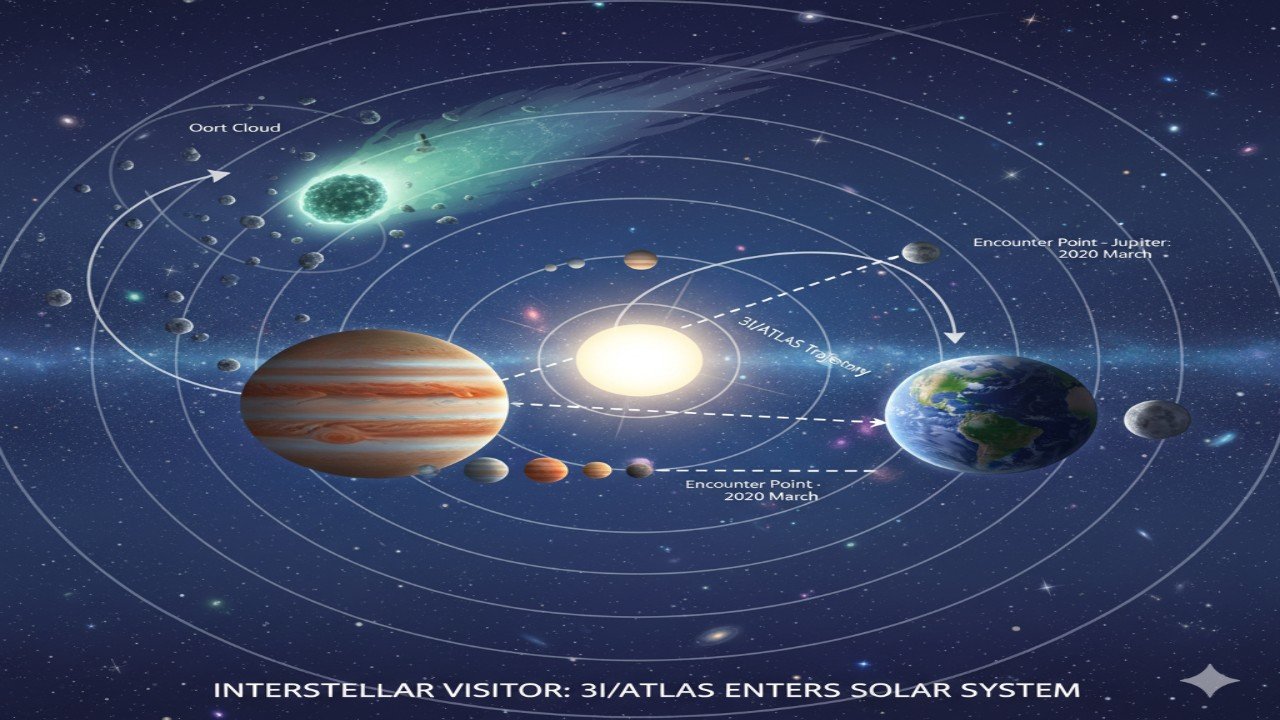
Introduction: A Visitor That Challenges Everything We Know
Every once in a century, something arrives from the depths of interstellar space that forces humanity to question its understanding of physics, astronomy, and even the possibility of extraterrestrial intelligence. Today, that cosmic visitor is 3I Atlas—a bizarre, unpredictable, and scientifically baffling interstellar object whose behavior is so unusual that it has shaken the scientific community.
The 3I Atlas mystery has become one of the most talked-about subjects among astronomers, because this object behaves neither like a typical comet nor like a stable asteroid. Instead, it defies natural laws in ways that leave even top scientists scratching their heads.
As data flows in from observatories across the world—from the James Webb Space Telescope to national observatories—experts are comparing this object to historical anomalies such as the famous ʻOumuamua, the 1977 Wow! Signal, and comet Borisov, all of which challenged conventional scientific models.
This article breaks down the 10 shocking scientific anomalies of 3I Atlas, why it has become an international research obsession, and what this means for our future understanding of the universe.
Why 3I Atlas Has Become a Global Puzzle
To understand why the 3I Atlas mystery is so important, you must first know how unusual it is when an interstellar object enters our solar system. Unlike normal comets that were born with the Sun, interstellar objects come from far beyond—perhaps even from another star system entirely.
Scientists have compared 3I Atlas with data from NASA, ESA, and multiple ground-based telescopes. For reference about space missions, visit the NASA site → https://www.nasa.gov.
You can also find additional interstellar object research at the European Space Agency → https://www.esa.int.
But as more observations are collected, one thing is clear:
3I Atlas is breaking rules. Scientific rules. Physical rules. Predictive rules.
Let’s explore the 10 strange anomalies scientists have identified.
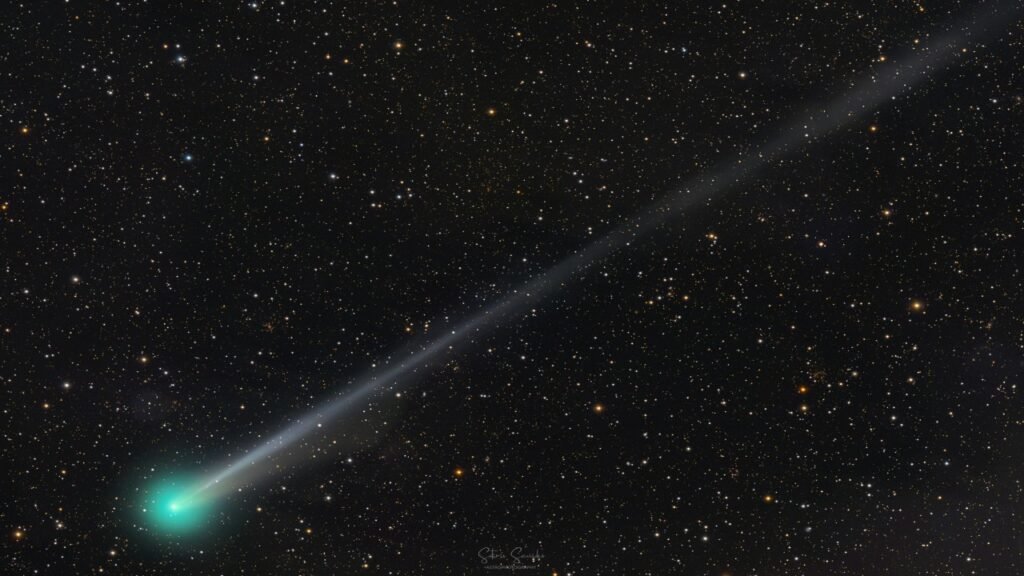
1. A Trajectory That Opposes Planetary Motion
All planets orbit the Sun in the same direction, following a predictable pattern.
But 3I Atlas appears to be moving in a near-opposite direction, raising immediate red flags.
This reverse-like motion is extremely rare and typically seen only in interstellar visitors—not in our native solar objects.
2. The Tail Faces the Sun, Not Away From It
Comets develop tails because the Sun heats their surface, causing dust and gas to escape away from the Sun.
But 3I Atlas has done the unimaginable:
Its tail forms toward the Sun.
This contradicts basic cometary physics and suggests either an unknown force or an unusual chemical property influencing its behavior.
3. A Massive Body Moving at Impossible Speed
Large objects should move slowly through space.
Small objects move faster.
But 3I Atlas, despite having a huge estimated mass, is moving at extreme speed, behaving like a lightweight object with high acceleration.
This challenges traditional Newtonian dynamics and indicates a possible non-natural propulsion influence.
4. Perfect Planet-by-Planet Timing
As it entered our solar system, 3I Atlas maneuvered past multiple planets in perfect timing, avoiding collision and maintaining a smooth trajectory.
Natural comets do not show such intelligent navigation.
This near-intentional path has added fuel to the debate about its true nature.
5. An Industrial-Level Nickel Composition
Most comets contain water ice, dust, and iron.
But 3I Atlas is unique: it has high nickel content, almost no iron, and limited volatile elements.
High-nickel objects can sometimes point toward industrial processes—raising new questions about artificial origins.
6. Only 4% Water Content
A normal comet contains a large amount of water ice.
3I Atlas contains only 4% water and 96% dust and rock.
This is highly unusual and not consistent with typical solar-system comets.
7. Extreme Negative Polarization of Light
When telescopes shine light on 3I Atlas, the reflected light behaves strangely.
Instead of scattering like normal comet surfaces, the object reflects polarized light in a way that indicates:
- unusual surface texture
- possible metallic coating
- abnormal absorption patterns
This behavior has no match in current comet databases.
8. It Entered From the Region of the 1977 Wow! Signal
In 1977, a mysterious radio signal shocked astronomers—known as the Wow! Signal.
3I Atlas entered our solar system from just 9° away from that location.
Is it coincidence?
Are these regions related?
Could something from that direction be sending objects intentionally?
The scientific community is actively discussing these possibilities.
Research about the Wow! Signal is available on the SETI Institute website → https://www.seti.org.
9. The Mysterious Blue Glow
As 3I Atlas passed near the Sun, it began emitting a bright blue glow that scientists cannot fully explain.
Is it:
- recharging through solar radiation?
- emitting ionized gases?
- bending light through unknown materials?
The blue emission remains one of the most puzzling aspects.
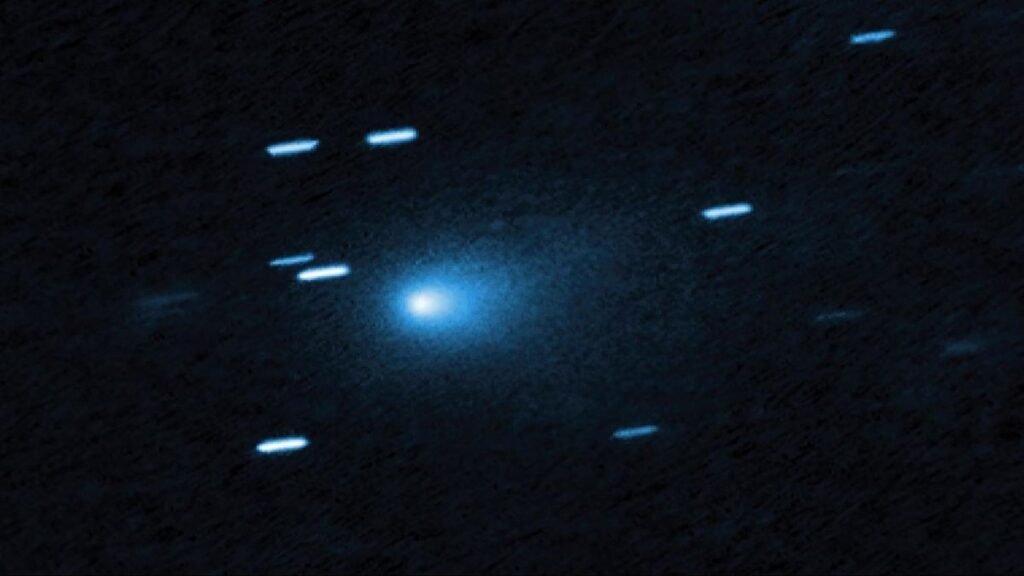
10. Non-Gravitational Acceleration
Perhaps the most shocking anomaly of all:
3I Atlas changed direction suddenly—
a massive object altering its path without gravitational influence.
This is the type of behavior we associate with:
- powered movement
- propulsion
- or intelligent navigation
While no one is claiming it is an alien spacecraft, many scientists agree that this shift is not typical of natural space objects.
Why December Matters — Earth Will Get a Close Look
3I Atlas will pass near Earth in December, giving researchers the best chance yet to examine whether a dust cloud, coma, or tail structure forms.
If it forms a cloud → it’s likely natural.
If it doesn’t → it may be the most unusual interstellar comet ever discovered.
Either way, the 3I Atlas mystery is rewriting scientific assumptions.
What This Means for the Future of Science
If 3I Atlas is natural, it will force updates to:
- physics
- comet behavior models
- astrophysical textbooks
- quantum mechanics
- our understanding of interstellar chemistry
If it is artificial, humanity will experience the most profound discovery in history.
Either way, our scientific worldview will change forever.
FAQs About 3I Atlas
1. Is 3I Atlas really an alien spacecraft?
No evidence confirms this. Scientists only say its behavior is unusual and needs deeper study.
2. Why is the tail facing the Sun?
This is one of the biggest mysteries. It contradicts standard comet physics.
3. Is 3I Atlas dangerous to Earth?
No. Its trajectory indicates a safe pass.
4. Why is the scientific community so interested?
Because 3I Atlas breaks multiple known physical laws and shows unique material behavior.
5. How is it different from ʻOumuamua?
Both are interstellar, but 3I Atlas has more physical and compositional anomalies.
6. Will NASA release more images?
Yes. NASA’s upcoming telescope observations are expected soon.
7. Can we see 3I Atlas with the naked eye?
No. It requires telescopic observation.
Conclusion
The arrival of 3I Atlas marks a historic moment. Whether it is a naturally extraordinary comet or something far more advanced, it challenges our scientific boundaries and pushes us toward a deeper understanding of the universe.
The 3I Atlas mystery is more than a cosmic curiosity—
it’s a reminder that we still understand only a fraction of the universe.
In the coming months, as more data becomes available, humanity may find itself rewriting the rules of physics… or embracing the possibility that we are not alone.
Either way, we are witnessing history.