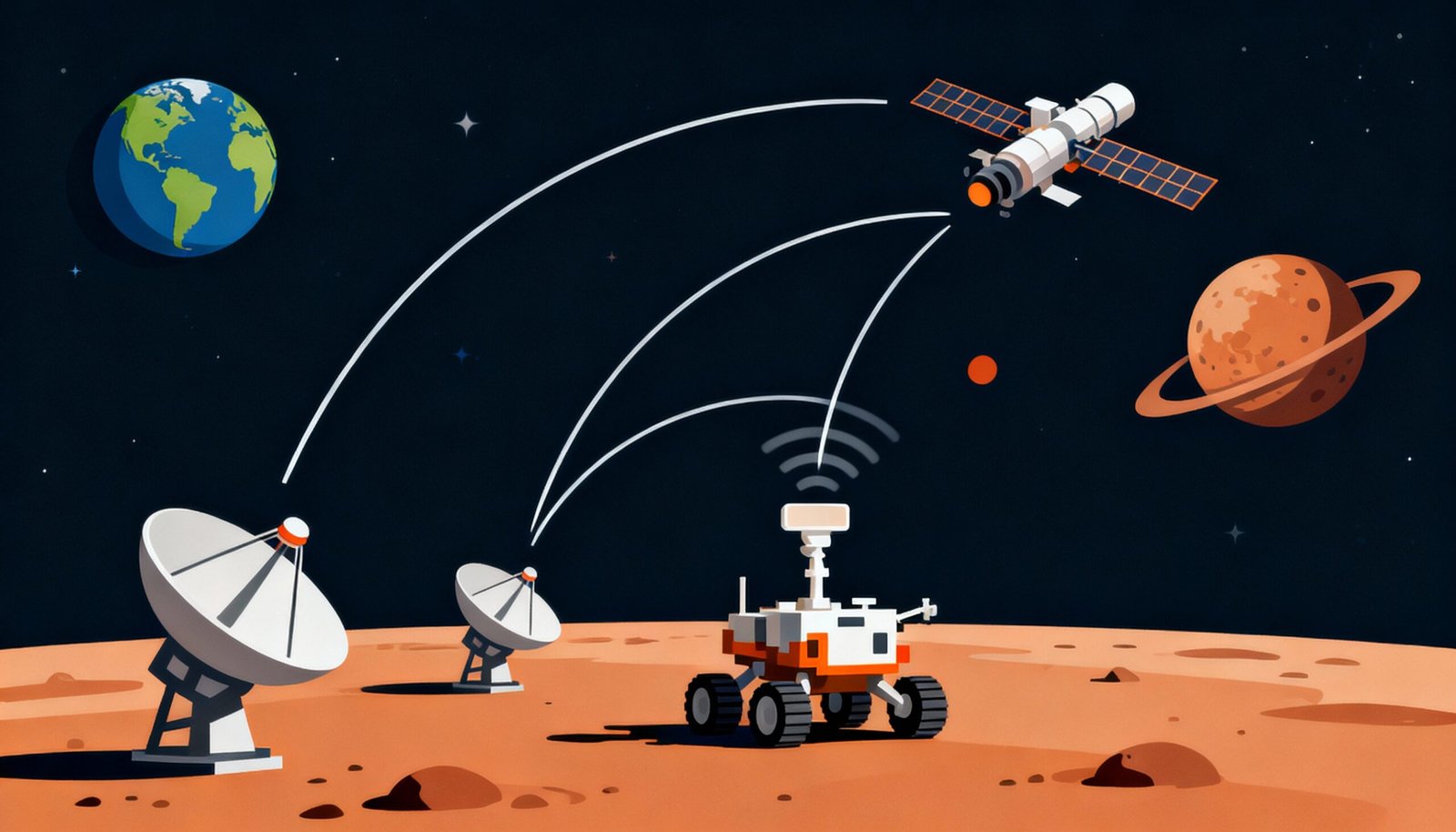
The Invisible Medium: How Spacecraft Talk Without Wires
Every command and image we receive from space travels not through wires or satellites — but through radio waves, the invisible messengers of light. Unlike sound, which needs air, radio waves are electromagnetic — meaning they move freely through the vacuum of space.
Each NASA spacecraft, from Voyager to New Horizons, carries a small transmitter (just 10–20 watts), sending binary-coded messages (0s and 1s) as modulated radio signals. These signals travel at the speed of light (300,000 km/s) — but weaken dramatically with distance.
By the time a Voyager transmission reaches Earth, it’s billions of times fainter than a phone signal. Yet, our planet hears it — thanks to an extraordinary global network.
Earth’s Giant Ears — The Deep Space Network
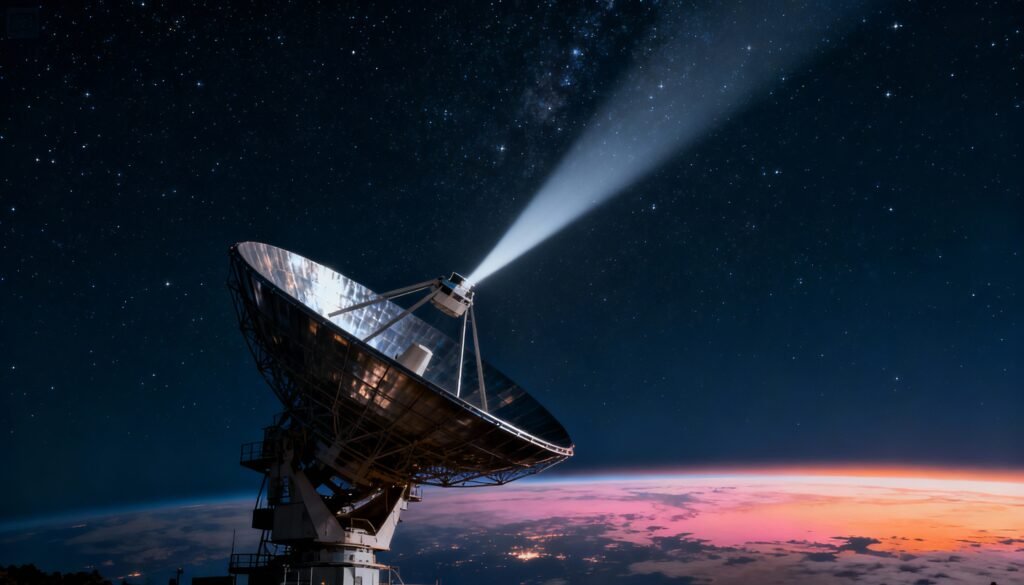
NASA’s Deep Space Network (DSN) is humanity’s interstellar phone line — a trio of 70-meter antennas spread across:
- Goldstone, California
- Madrid, Spain
- Canberra, Australia
This spacing (120° apart) ensures continuous contact with any spacecraft as Earth rotates.
Each station’s dishes are so sensitive they can detect a signal that’s trillions of times weaker than a flashlight’s glow.
Voyager: Humanity’s Longest Conversation
Launched in 1977, Voyager 1 and Voyager 2 are now the most distant human-made objects — Voyager 1 is over 24 billion kilometers from Earth.
Its signal takes 22 hours to arrive, and NASA’s commands take the same to return. That’s a 44-hour conversation delay — yet it still speaks.
Even with a 20-watt transmitter, Voyager’s radio whispers are caught by DSN’s immense antennas, decoded through error correction and cryogenic receivers.
Its RTG (plutonium generator) still powers a few instruments — studying interstellar space, magnetic fields, and cosmic particles.
New Horizons: Pluto’s Distant Postcard
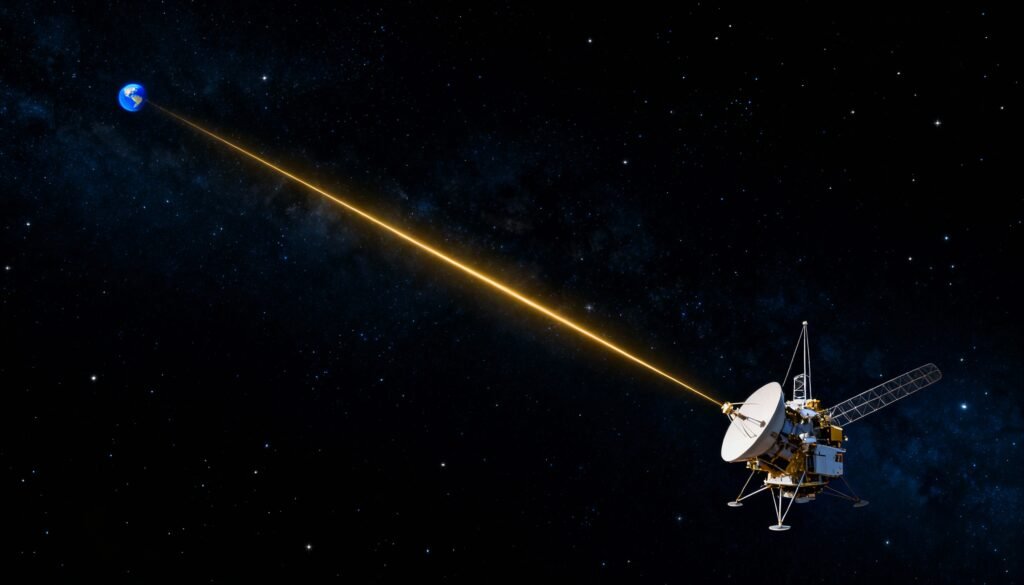
In 2015, New Horizons flew past Pluto, capturing breathtaking images of its icy plains.
Each photo took 4–6 hours to reach Earth — traveling 8 billion kilometers through emptiness.
Juno and the Battle with Jupiter’s Radiation
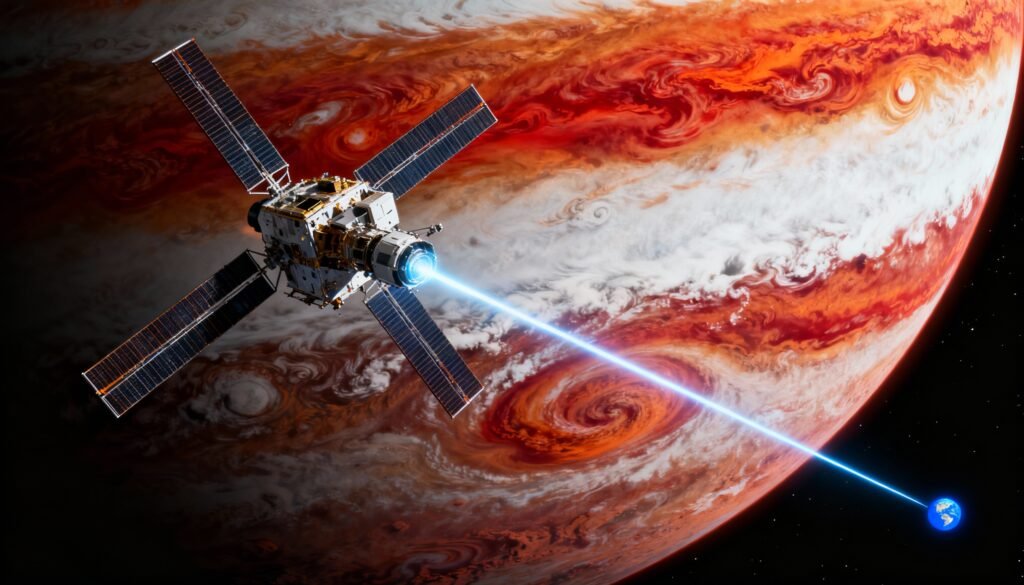
Orbiting Jupiter, the Juno spacecraft faces one of the harshest radio environments in the solar system.
Despite being bombarded by powerful radiation, Juno’s X-band radio keeps a clear connection — proof of NASA’s signal filtering and shielded communication systems.
Parker Solar Probe: Messaging from the Edge of the Sun
Parker Solar Probe ventures closer to the Sun than any craft in history — within 7 million km of its surface.
It communicates only when safely aligned, sending bursts of data through intense solar noise. NASA uses advanced heat-resistant antennas and timing windows to ensure every message arrives intact.
Mars Network: Relays Between Worlds
Unlike distant probes, Mars rovers don’t talk directly to Earth.
Instead, they send data to orbiters like MRO or MAVEN, which then relay it home.
This setup saves power and ensures contact even when the Sun blocks direct communication.
James Webb: High-Speed Data from Deep Space
Located 1.5 million km away at the L2 point, James Webb Space Telescope (JWST) uses Ka-band radio to transmit stunning images.
Unlike Voyager, it can send data at tens of megabits per second, showing how newer technology bridges immense distances faster.
The Future: From Radio to Laser Communication
NASA is now testing laser-based optical links (DSOC — Deep Space Optical Communications).
Lasers carry hundreds of times more data, ideal for 4K video or massive science uploads from Mars or beyond.
However, they require pinpoint accuracy — even a tiny misalignment can miss Earth entirely.
Challenges and Triumphs
| Challenge | Explanation | NASA’s Solution |
|---|---|---|
| Weak signals | Distance reduces signal power | Giant antennas, error correction |
| Delay | Light speed still limited by distance | Autonomy & pre-programmed commands |
| Interference | Solar radiation & cosmic noise | Advanced filters, shielded receivers |
| Limited power | RTG decay over decades | Smart power management |
| Pointing precision | Dishes must stay locked on target | Atomic clocks, Doppler tracking |
Why It Matters
Every time Earth receives a signal from a faraway spacecraft, it’s a reminder of human curiosity, persistence, and connection.
Across billions of kilometers, we’ve built a bridge — one made not of steel or fiber, but of light, patience, and imagination.
“Even at the edge of interstellar space, a whisper from Voyager still finds its way home.”