
A Glimpse Into the Past Every Morning
Every sunrise you witness is already a moment in history. The light that warms your face, paints the sky orange, and powers life on Earth actually left the Sun 8 minutes and 20 seconds earlier.
It sounds like time travel — and in a way, it is. Because light doesn’t reach us instantly, everything we see in the universe shows us the past, not the present.
The Speed of Light — Nature’s Universal Limit
Light travels incredibly fast — at about 299,792 kilometers per second (that’s roughly 186,000 miles per second).
Even at that unbelievable speed, the distance between the Sun and Earth — around 150 million kilometers (93 million miles) — means it takes light about 8 minutes and 20 seconds to make the journey.
That delay is why, if the Sun were to suddenly vanish (theoretically speaking), we wouldn’t know until 8 minutes later.
What You’re Really Seeing
When you look at the Sun (never directly without protection!), you’re seeing it as it was 8 minutes ago — not as it is right now.
The same principle applies across space:
- The Moon you see is 1.3 seconds old.
- The light from Jupiter takes about 43 minutes to reach Earth.
- The nearest star, Proxima Centauri, is 4.24 light-years away — meaning we see it as it was over 4 years ago.
- And galaxies billions of light-years away? We’re viewing them as they looked billions of years in the past.
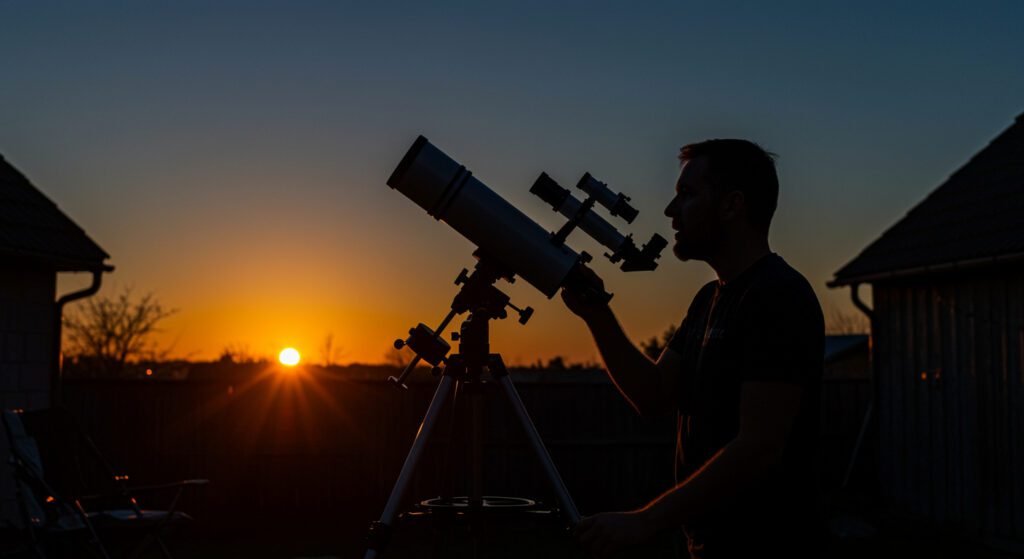
Every telescope, every stargazer, every astronomer — we’re all looking back through time.

How Telescopes Let Us “See the Past”
When astronomers use space telescopes like Hubble or James Webb, they’re not just seeing distant stars — they’re seeing ancient light.
Some galaxies visible to us today emitted their light before Earth even existed.
That’s why studying deep space helps scientists understand the early universe, the formation of galaxies, and how cosmic structures evolved over billions of years.
Light as the Universe’s Time Machine
In space, distance equals time.
The farther away something is, the older the light we receive from it.
Every star, planet, or galaxy we observe is like a postcard from the past — traveling across the cosmos for thousands or even billions of years before reaching our eyes.
So, in a sense, the night sky is the universe’s history book, written in beams of ancient light.
Fun Cosmic Facts
- The light from the Andromeda Galaxy takes 2.5 million years to reach Earth.
- When you look at the North Star (Polaris), you see it as it was about 430 years ago.
- The farthest galaxies observed by the James Webb Space Telescope show light from 13 billion years ago — nearly the dawn of time.
Final Thought — You’re a Time Traveler Too
Every time you look up, you’re witnessing the past — from 8 minutes ago to billions of years ago.
That’s the magic of astronomy: it reminds us how vast, connected, and mysterious our universe truly is.
So tomorrow morning, when sunlight touches your face, remember — it began its journey long before your alarm went off.