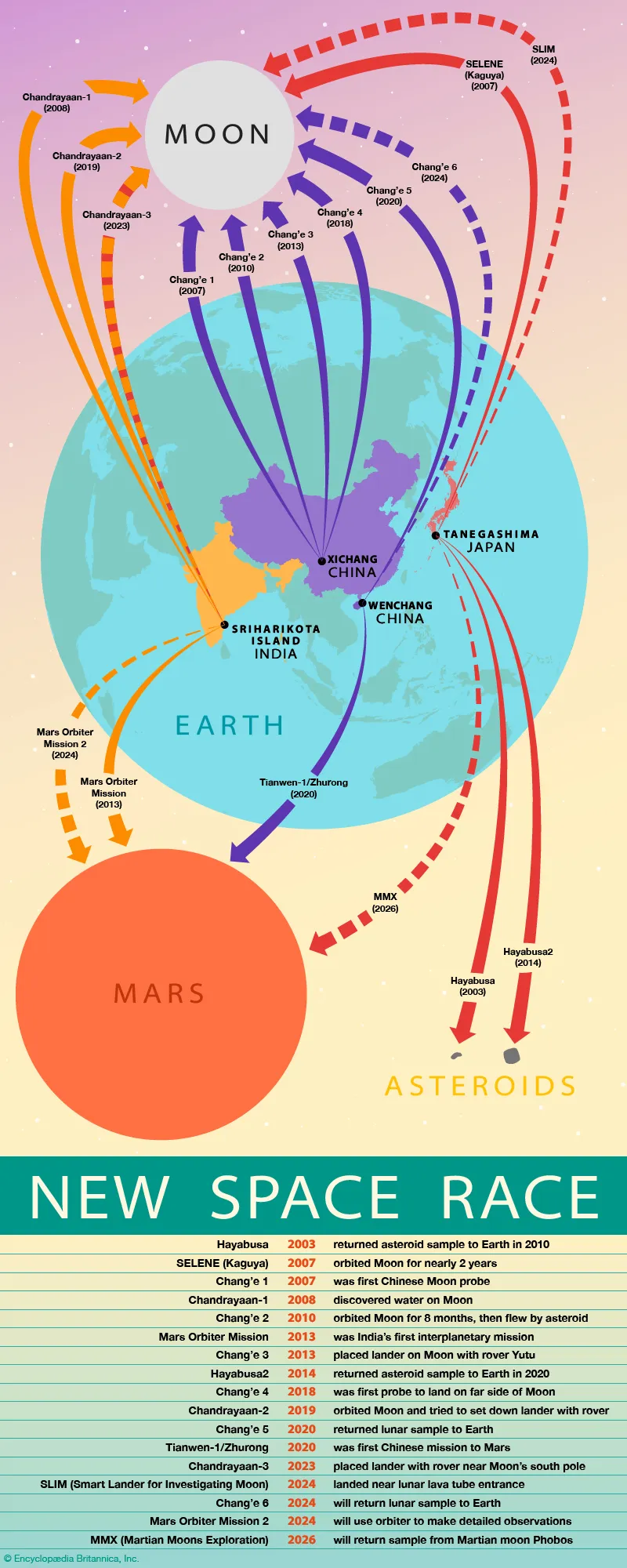
Imagine this: you open your morning news feed and read that within the next decade a rocket launched from India could arrive on a lunar base developed by China, while a U.S. commercial spacecraft delivers logistics for a Mars-orbital station. Welcome to the next space race—a three-way contest that’s less about planting flags and more about global power, strategic tech, and new frontiers beyond Earth.
In this article we’ll take a deep dive into how the U.S., China and India are each positioning themselves in this emerging contest — exploring their ambitions, strengths, and the broader implications of this modern space rivalry.
We’ll look at the players side by side, draw out key insights, and reflect on what it means for humanity, not just geopolitics.
1. Setting the Stage: Why We’re In a New Space Race
The original space race of the 1960s featured the NASA vs the Soviet Union. en.wikipedia.org+1 Today’s competition is different for three key reasons:
- Multiple major players: It’s not just two superpowers anymore. India is now firmly in the mix. ACE
- Commercial and state arms blended: Private firms are powerful tools of national strategy.
- Strategic domains widened: From lunar landings to satellite dominance, Earth-orbit assets, cislunar zones, and Mars ambitions. Progressive Policy Institute
So when we talk about the next space race, we’re talking about technical prowess, economic competition, national prestige, and strategic security all rolled into one.
2. Where Each Power Stands: USA vs China vs India
Here’s a high-level comparison of how the key players stack up today:
| Country | Key Missions & Strengths | Strategic Weaknesses |
|---|---|---|
| USA | Artemis program (return to Moon), robust commercial space sector (e.g., SpaceX, Blue Origin), heavy innovation base. Progressive Policy Institute | Budget constraints, regulatory & programme delays, fragmentation between agencies/private players. |
| China | Independent human spaceflight capability, Chang’e lunar programme, planned lunar base and sample return missions. en.wikipedia.org+1 | Less global partnership (due to US bans), transparency issues, still catching up in deep space human missions. The Geopolitics |
| India | Cost-efficient missions, rising confidence (e.g., lunar south pole landing via ISRO), developing human spaceflight capability (Gaganyaan). en.wikipedia.org+1 | Smaller budget, less infrastructure, high ambitions vs resources gap. |
2.1 USA: Maintaining the Lead
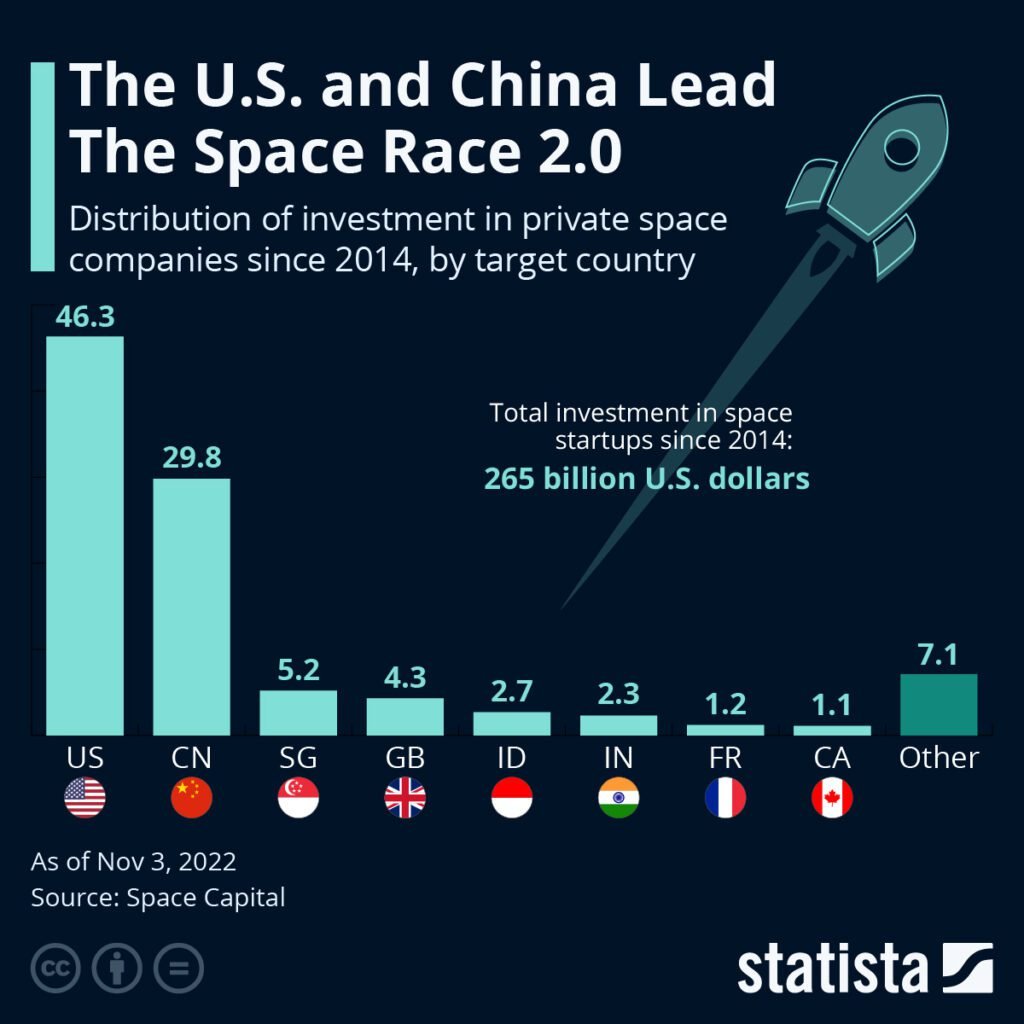
The U.S. aims to retain its dominance in space technologies, particularly via the Artemis programme and deep-space infrastructure. The commercial sector provides agility. But delays and rising costs are a growing concern. The recent report suggests China could overtake if the U.S. doesn’t accelerate. Live Science
Read Also: SpaceX Starship Earth-to-Earth Travel Explained
2.2 China: Catch-Up and Challenge
China’s space programme moves with great coordination between state and industry. With successful moon missions and a modular space station, they are racing ahead in some domains. Analysts highlight that “China is still far ahead of everybody else” among emerging competitors. Room The Space Journal of Asgardia
2.3 India: The Rising Underdog
India brings one of the most cost-efficient and innovative space programmes in the world. A recent soft landing near the lunar south pole by ISRO stood out. AP News India aims to send astronauts, build a station by 2035 and secure a place among major space powers.
Also Read: ISRO’s Bluebird Satellite Series: India’s Leap in Space Tech
3. Unique Insights & Fresh Perspectives
3.1 A Shift from Solo Flags to Strategic Networks
In the original race, planting the flag was the goal. Now it’s more about establishing enduring networks: satellite constellations (for navigation, communications), cislunar logistics hubs, and even lunar mining. China’s “Space Silk Road” initiative shows how space strategy now interlinks with global infrastructure. Live Science
3.2 Cost Efficiency as Strategic Weapon
India’s low-cost missions have changed the expectation of what is possible. For example, the Mars Orbiter Mission (Mangalyaan) achieved success at a fraction of typical costs. en.wikipedia.org This kind of cost leadership means India could scale and innovate rapidly, even if budget totals are smaller.
3.3 Private Sector as Game Changer
In the U.S., commercial entities such as SpaceX have transformed launch economics and opened new possibilities for reuse and rapid turnaround. This dynamic could tip the balance of power in the next space race more than raw government budget.
3.4 Asia-Pacific as the New Theater
While the U.S. still leads, the centre of gravity for the next space race is shifting east. Asia-Pacific launch sites, partnerships and ambitions now dominate the headlines. According to one analysis: “Asia’s space race: China leads India on strategy”. lowyinstitute.org
3.5 Geopolitical vs Cooperative Futures
It’s tempting to view this as purely competitive, but cooperation remains possible. Even rivals share scientific data or collaborate on global challenges (space debris, Earth monitoring). One commentary argues: avoiding a “folly” of space confrontation requires learning from Soviet-era cooperation.
4. Why It Matters: The Bigger Picture
- National Security & Earth Domination: Control of satellite networks, space-based anti-missile systems or lunar resources could shift military advantage.
- Economic Spillovers: Space technology drives telecommunication, navigation, remote sensing, climate monitoring technologies.
- Human Inspiration & Soft Power: A mission to Mars or Moon resonates globally and shapes national identity.
- Planetary Challenges: Coordinated space efforts can help monitor climate change, track asteroids, develop space-based solar power.
5. Roadmap Ahead: What to Watch
Here are key milestones and metrics to follow in the next decade:
- Moon landings & lunar base construction: Will China or the U.S. host the first sustainable lunar base?
- Human missions beyond low Earth orbit: Which country first sends humans back to the Moon or onward to Mars?
- Satellite megaconstellations & navigation systems: Who dominates next-gen global connectivity—GPS, BeiDou, NavIC?
- Launch cadence and reusability: How cost-efficient will launches become, and who leads the launch market?
- International partnerships: Will new coalitions form (India with Europe, China with emerging space nations)?
- Commercial vs state resources: How private sector involvement multiplies national capacity.
6. Conclusion: Entering A New Era of Exploration
The next space race isn’t simply about which country plants the next flag—it’s about who builds the infrastructure, control systems and networks that make the rest of Earth’s and humanity’s future possible. The U.S., China and India each bring distinct strengths to this contest: innovation and private sector muscle, centralized planning and lunar ambition, cost-efficiency and emerging human spaceflight respectively.
As someone who follows space news closely, I see this era as uniquely promising. The pace of launches, the rise of new players and the blurring of national/commercial boundaries all tell me that the 2020s and 2030s might be the most transformative decades yet in human exploration.
Your part? Stay curious. As this space race unfolds, every student, enthusiast or citizen will be able to watch history in motion—and even imagine how we all might stand on the Moon, or one day Mars, as representatives of a united humanity rather than just one country.